
Home / what-is-drayage
What Is Drayage at a Trade Show? A Complete Exhibitor Guide
Drayage, also called material handling, is the service provided by a trade show’s official contractor to move your booth materials from the loading dock to your exhibit space and back after the event. Drayage fees are separate from freight shipping and are typically calculated based on the weight of your shipment.
Understanding how drayage works is essential for budgeting and avoiding unexpected convention center charges.
🔹 What Does Drayage Include?
Drayage services typically include:
Unloading freight from your carrier’s truck
Moving crates to your booth space
Storing empty crates during the show
Returning empty crates at move-out
Reloading freight onto outbound carriers
It does not include:
Shipping from your warehouse
Installation labor
Electrical services
Drayage is strictly material handling inside the venue.
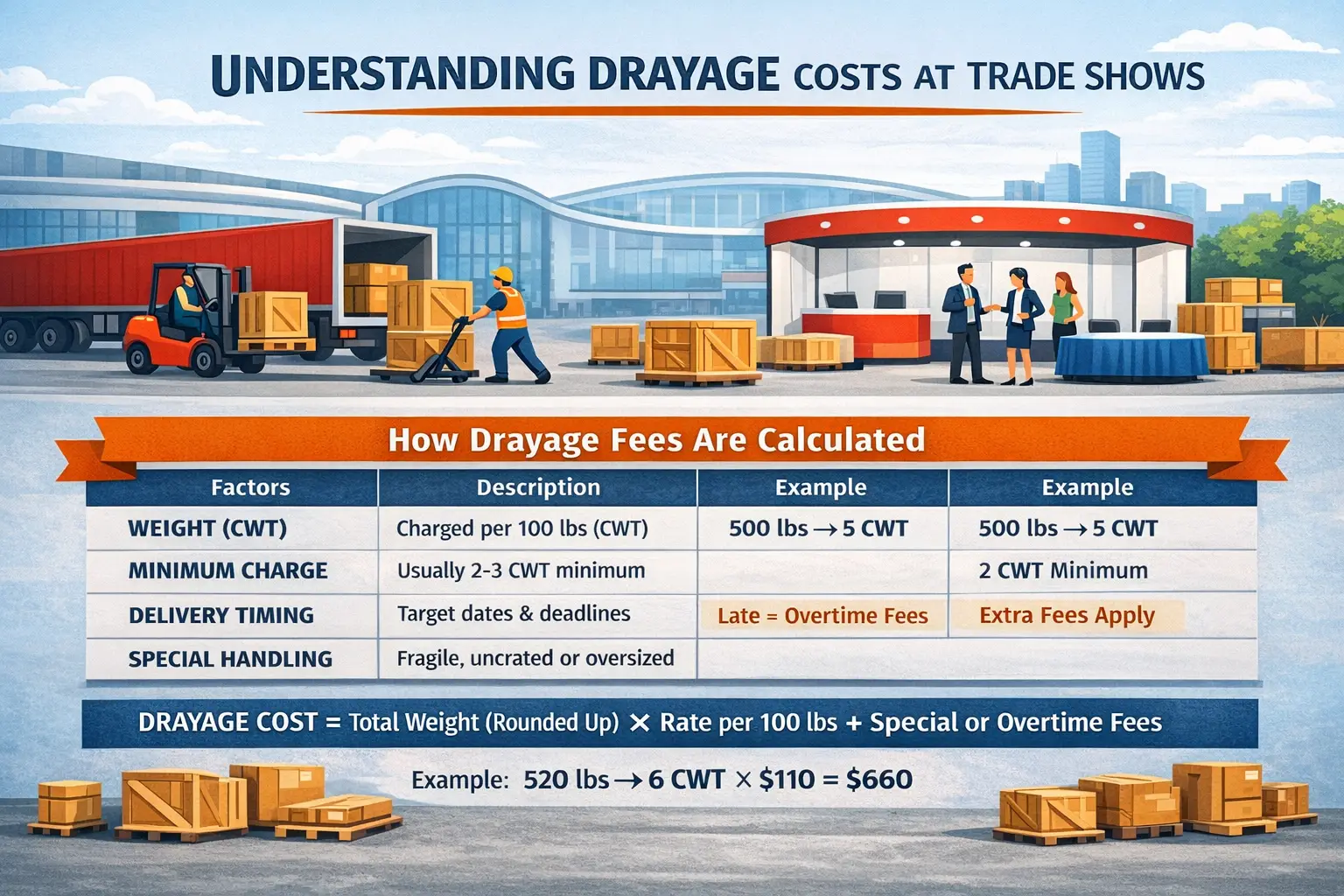
🔹 How Is Drayage Calculated?
Drayage fees (also called material handling) are charges assessed by the show’s official contractor for moving your freight inside the venue — from the carrier’s truck or advance warehouse to your booth space and then back at the end of the show.
Here are the core factors that determine how much you’ll pay:
📍 1. Weight (CWT) — the foundation of most drayage pricing
Drayage is usually billed by the hundredweight (CWT) — meaning “per 100 pounds.” For example, 1 CWT = 100 pounds.
If your shipment weighs 412 lbs, it’s rounded up to 5 CWT
If it weighs 301 lbs, it becomes 4 CWT
Most shows require you to pay based on the next whole 100 lbs, not partial weights.
🪙 2. Minimum weight per shipment
Many shows impose a minimum charge — often 2–3 CWT — even if your shipment is lighter. That means a tiny shipment can still trigger a base cost.
🕰️ 3. Timing and delivery window
Shows define “target” delivery dates for advance warehouse and direct-to-site shipments. Arriving outside these windows can trigger:
non-standard rates
overtime labor fees
higher CWT charges
because extra labor or scheduling is required.
📦 4. Type of freight and handling required
Not all freight is equal:
Crated freight is typically cheapest because it’s easy to move.
Palletized or pad-wrapped items may incur additional fees.
Special handling freight (oversize, irregular shape, fragile, or mixed pieces) often adds significant cost because it takes extra time, equipment, or labor.
⏱️ 5. Overtime or after-hours work
Move-in or move-out operations outside standard hours often cost more per CWT because labor rates increase (overtime pay).
📊 Example of How Drayage Gets Calculated
Let’s say your booth materials arrive weighing 412 pounds and the show charges $120 per CWT with a 3 CWT minimum:
Weight is rounded up to the next 100:
412 lbs → 5 CWT charged.Cost = 5 CWT × $120 = $600 in drayage fees
If your shipment required “special handling” (e.g., no crate, awkward shape, or delivered late), additional fees could be added to that total.
🤔 Why Drayage Often Surprises Exhibitors
Many shipments have multiple pieces — each piece may trigger minimum charges.
Some shows treat small boxes as special handling, increasing fees.
Separate line items like storage of empty crates and return handling also add cost.
The show contractor (General Contractor) sets these fees and exhibitors must comply.
🪶 Tips to Keep Drayage Costs Under Control
✔ Consolidate multiple small packages — one large shipment usually costs less overall than many small ones.
✔ Use crated freight rather than loose items when possible.
✔ Ship to advance warehouse on time — missing target windows can cost more.
✔ Minimize unnecessary weight — heavy props, extra furniture, and non-essential items add cost.
📌 TL;DR — Quick Formula
Drayage Fee = (Total Weight → Rounded to Next 100 lbs) × CWT Rate (+ any special, overtime, or handling fees)
That means 412 lbs becomes 5 CWT before the math even begins.
🔹 Advance Warehouse vs Direct to Show Site
Most shows offer two shipping options:
Advance Warehouse
Freight arrives before move-in
Stored by the general contractor
Delivered to booth during scheduled time
Direct to Show Site
Freight arrives during move-in
Must meet assigned target dates
May face delays if truck traffic is heavy
Each option has different deadlines and labeling requirements.
🔹 Why Drayage Surprises First-Time Exhibitors
Many exhibitors budget for:
Booth cost
Graphics
Shipping
But forget material handling.
Drayage can range from several hundred dollars to several thousand dollars depending on weight and show location.
Major convention centers like McCormick Place (Chicago) and Las Vegas Convention Center often have higher material handling rates than smaller regional venues.
🔹 How to Reduce Drayage Costs
Exhibitors can lower material handling costs by:
Choosing lightweight portable displays
Reducing crate weight
Minimizing unnecessary structural components
Combining shipments when possible
Planning freight timing carefully
Lightweight aluminum frame systems with fabric graphics often reduce overall handling weight.
🔹 Drayage vs Shipping: What’s the Difference?
Shipping refers to transporting your booth materials from your warehouse to the show location.
Drayage refers to moving those materials inside the convention center.
They are separate charges handled by different entities.
Your freight carrier does not control drayage fees — the show’s official contractor does.
🔹 Is Drayage Included in Every Trade Show?
Some events include basic drayage in the booth space rate, while others charge separately.
Always review the exhibitor service manual to confirm whether material handling is included or billed separately.
Even when included, specific rules must be followed to avoid penalties.
🔹 Final Advice for Exhibitors
Before finalizing your booth selection, consider total exhibiting cost:
Booth structure
Graphics
Freight shipping
Drayage
Labor
Electrical
A lower-cost display that weighs significantly more may end up costing more in drayage fees over time.
Understanding drayage early prevents budget surprises later.
What is drayage in simple terms?
Drayage is the service that moves your booth materials from the loading dock to your exhibit space inside a convention center.
Is drayage the same as shipping?
No. Shipping moves your freight to the venue. Drayage moves it inside the venue.
How much does trade show drayage cost?
Costs vary by show and weight but are typically calculated per hundred pounds of freight.
Can I avoid paying drayage?
Drayage typically applies when freight is delivered through the convention center loading dock and handled by the show’s official contractor. However, in some cases, exhibitors may avoid drayage charges by personally carrying small, hand-carried items through the main entrance. Most convention centers allow exhibitors to bring in materials that can be safely transported without dollies, carts, or powered equipment.
Rules vary by show and venue, so exhibitors should always review the official exhibitor service manual before planning to hand-carry materials.