
Home / union-labor-rules
Union Labor Rules at Trade Shows: A National Exhibitor Guide
Union labor rules at trade shows vary depending on the venue, the city, and the specific event. In some major convention centers, certain installation, electrical, and material handling tasks fall under union jurisdiction. In other cities, exhibitors have more flexibility.
Understanding which locations are more regulated — and how labor is typically structured — helps exhibitors plan accurately and avoid unexpected labor charges.
🔹 What Are Union Labor Rules?
Union labor rules determine which tasks must be performed by union personnel during trade show move-in, installation, and dismantle.
These rules are influenced by:
Local labor agreements
Convention center policies
Show-specific contracts
The appointed General Contractor
They are not the same in every city.
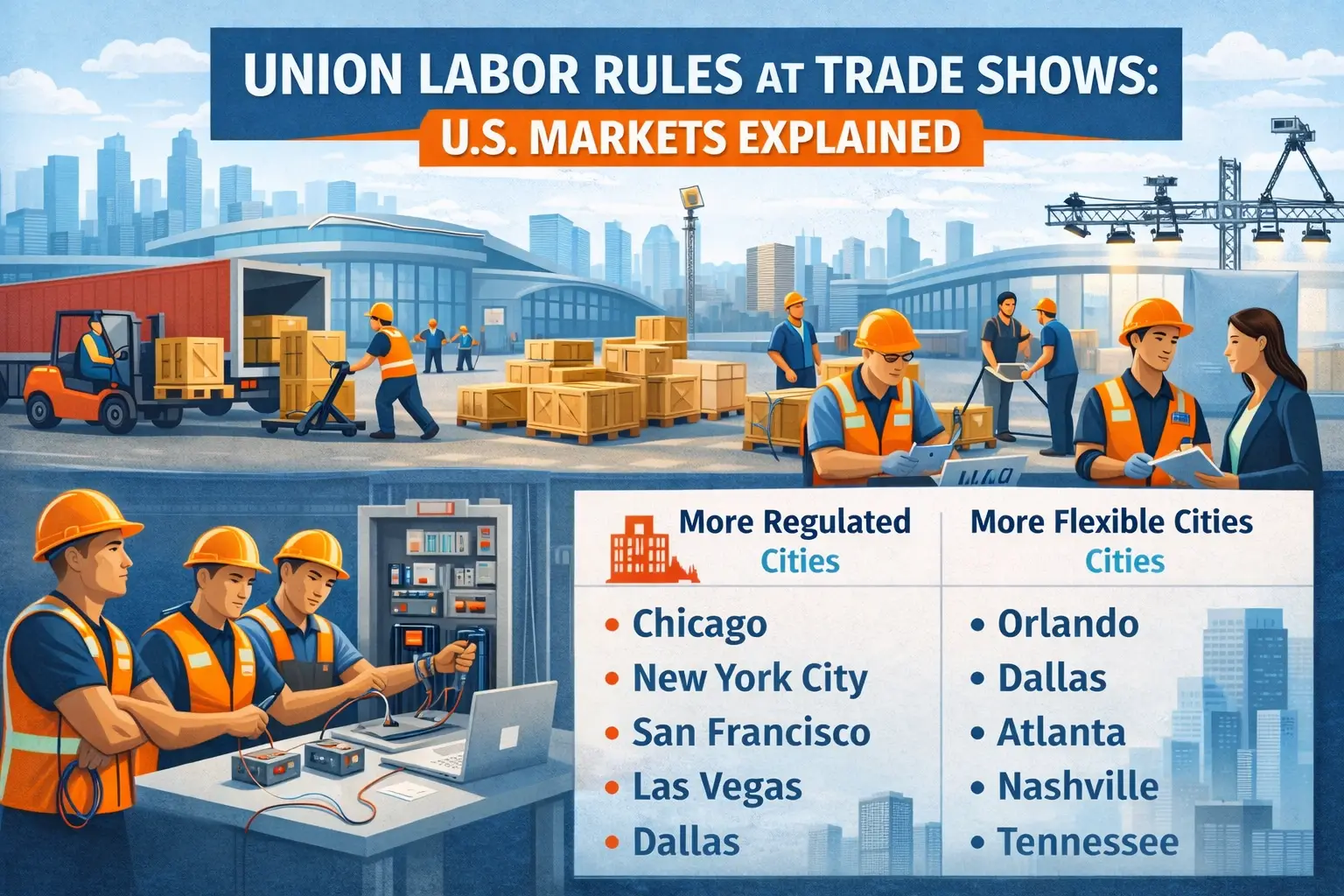
🔹 Cities & States with Higher Labor Regulation
Certain major convention markets are known for stricter labor jurisdiction:
🔴 Historically More Regulated Markets
Chicago, Illinois
New York City, New York
Boston, Massachusetts
Philadelphia, Pennsylvania
San Francisco, California
Las Vegas, Nevada (varies by task)
In these markets, electrical, rigging, forklift operation, and certain carpentry tasks are commonly under union jurisdiction.
Minimum labor calls and overtime rules are also more common.
🔹 Markets with More Flexibility
Many regional and mid-sized convention centers allow greater exhibitor setup freedom.
Examples often include:
Orlando, Florida
Dallas, Texas
Atlanta, Georgia
Nashville, Tennessee
Phoenix, Arizona
Charlotte, North Carolina
While electrical work is almost always regulated everywhere, portable inline booth assembly is typically allowed by exhibitor personnel in these cities.
(Always verify the exhibitor manual — policies can change.)
🔹 What Exhibitor Personnel Are Commonly Allowed to Do
In many U.S. markets, exhibitor employees may:
Unpack crates
Assemble lightweight portable booths
Install graphics
Use basic hand tools
Connect plug-and-play lighting
However, restrictions may apply to:
Power tools
Ladders over certain heights
Structural modifications
Electrical wiring
Suspended signs (rigging)
🔹 Tasks Frequently Under Union Jurisdiction
Across most major convention markets, union labor commonly handles:
Electrical distribution
Ceiling rigging
Forklift operation
Dock freight handling
Structural carpentry
Heavy equipment placement
Even in less regulated markets, electrical service usually must be ordered through approved providers.
🔹 What Is a “Minimum Labor Call”?
In many regulated cities, hiring union labor triggers a minimum billing period — often 1 to 4 hours — even if the task takes 20 minutes.
This is where planning matters.
A poorly scheduled installation can significantly increase costs.
🔹 How Labor Rules Affect Booth Selection
Labor jurisdiction can influence:
Booth design complexity
Weight of structure
Assembly time
Tool requirements
Total show budget
Lightweight modular or portable systems often reduce exposure to labor costs in more regulated cities.
🔹 How to Plan for Different Markets
Before every show:
Review the Exhibitor Service Manual
Confirm labor jurisdiction rules
Understand target move-in schedules
Clarify what tools are permitted
Confirm whether power tools are restricted
Every show can vary — even within the same city.
Do all trade shows require union labor?
No. Labor rules depend on the city, venue, and event. Major convention markets often have stricter jurisdiction than regional venues.
Is electrical work always union?
In most U.S. convention centers, electrical service must be ordered through approved providers, even in less regulated markets.
Can I assemble my own booth?
In many cities, lightweight portable booths can be assembled by exhibitor staff. Larger custom exhibits may require union assistance.
Why do labor rules differ by city?
Labor agreements are negotiated locally and vary based on regional union contracts and venue policies.