
Modular Booth vs Portable Booth Systems: What’s the Difference?
Exhibitors often compare modular booth systems and portable trade show displays when planning their exhibit strategy. While both offer flexibility and reusability, they differ in structure, scalability, labor requirements, and long-term cost considerations.
Understanding these differences helps exhibitors select the right system based on show frequency, booth size, and budget goals.
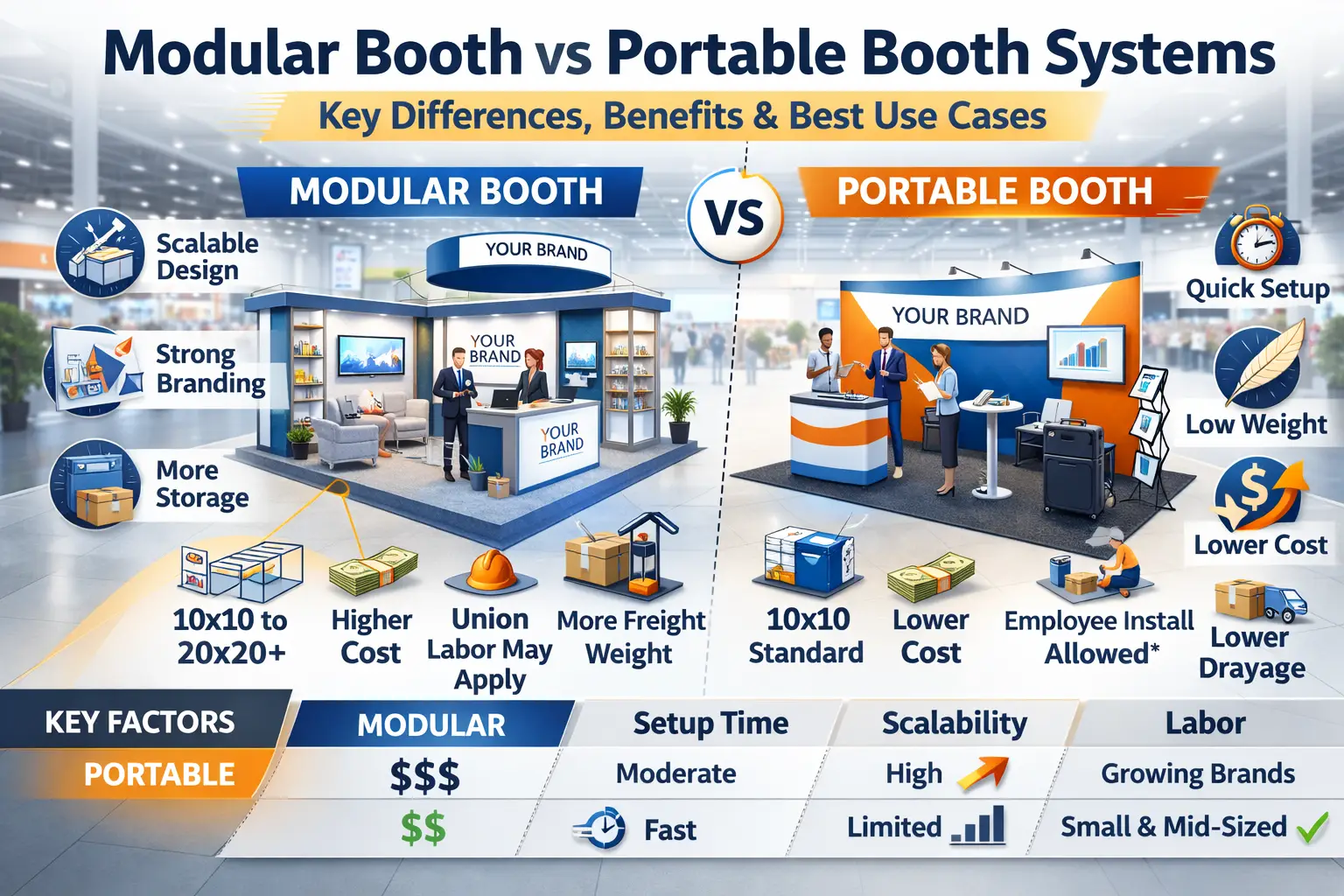
🔹 What Is a Portable Booth System?
Portable booth systems are lightweight display solutions designed for easy transport and fast setup.
They typically include:
Aluminum or collapsible frames
Fabric or tension graphics
Tool-free or minimal-tool assembly
Compact shipping cases
Portable systems are commonly used for:
10×10 inline booths
Regional trade shows
Exhibitors managing costs
Companies with small teams
🔹 What Is a Modular Booth System?
Modular booth systems are engineered structures built from reusable aluminum framing components that can be reconfigured into multiple booth sizes and layouts.
They typically include:
Structural aluminum frames
Interchangeable panels
Integrated lighting
Shelving, counters, and storage
Customizable configurations
Modular systems are commonly used for:
10×20 and larger inline booths
Island exhibits
Exhibitors attending multiple shows
Brands requiring stronger architectural presence
🔹 Key Differences
1️⃣ Structure & Build
Portable:
Lightweight, quick-assembly, minimal hardware.
Modular:
Stronger framing, engineered connections, more architectural design flexibility.
2️⃣ Scalability
Portable:
Limited expansion capability.
Modular:
Can expand from 10×10 to 20×20 or island configurations using the same structural components.
3️⃣ Labor & Installation
Portable:
Often eligible for exhibitor self-install (employees only, hand tools).
Modular:
May require installation labor depending on size and complexity.
In more regulated convention markets, modular systems may increase labor exposure compared to simple portable backdrops.
4️⃣ Drayage & Freight Impact
Portable:
Lower weight → lower material handling costs.
Modular:
Heavier but more efficient than traditional custom wood builds.
Weight still plays a role in material handling pricing.
5️⃣ Brand Impact
Portable:
Clean, professional, cost-efficient.
Modular:
Stronger architectural presence and design depth.
🔹 Cost Comparison (General Range)
Portable inline system:
$3,000 – $15,000
Modular system:
$10,000 – $40,000+
Investment depends on size, lighting, storage, and configuration flexibility.
🔹 When Portable Is the Better Choice
Choose portable if:
You exhibit 1–3 times per year
You primarily exhibit in 10×10 spaces
You want minimal labor exposure
Budget control is a priority
🔹 When Modular Is the Better Choice
Choose modular if:
You exhibit multiple times per year
You scale between 10×10, 10×20, and island spaces
Brand presence is critical
You want reconfigurable long-term ROI
🔹 Hybrid Strategy (Often Ideal)
Many exhibitors:
Own a modular structural system
Use portable add-ons
Refresh graphics per event
Scale booth size as needed
This balances flexibility and long-term cost efficiency.
Is modular better than portable?
Not necessarily. Modular systems offer scalability and a stronger visual presence, while portable systems offer cost efficiency and ease of installation.
Can modular booths be reused?
Yes. Modular systems are specifically designed for reconfiguration and reuse across multiple shows.
Do modular booths require union labor?
Not automatically. Labor requirements depend on booth size, complexity, and venue rules.
Are portable booths considered professional?
Yes. Modern portable systems provide seamless graphics and clean presentation suitable for most inline exhibits.